

Sunscreen
A little dab will do you?

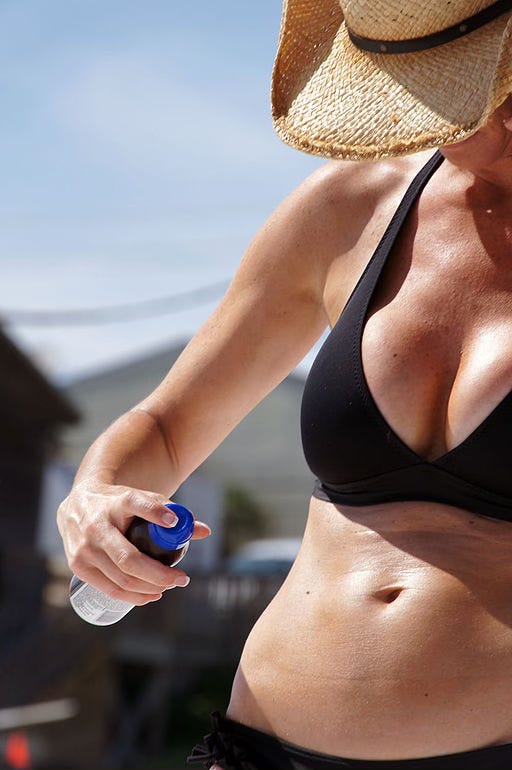
Sunscreen, when applied appropriately, can prevent forms of skin cancer.
HotlantaVoyeur, CC BY 2.0 <https://creativecommons.org/licenses/by/2.0>, via Wikimedia Commons
When applying sunscreen, it is often recommended that a person use a lot. And fair enough, everyone is subject to getting skin cancer—even non-melanin challenged folks. Sunscreen has an interesting history, as well. In the 1970s to 1980s, PABA (or para-aminobenzoic acid) was the preferred goto sunscreen aid. However, it was later discovered that it promoted skin sensitivity to cancer, as well (Hamilton).
Enter the 40 years into the future, sunscreen formulation chemistry is still part- science and investigations into the best formulation have not abated. Depending on where you reside in the world, skin cancer is a cause of higher morbidity rates. People residing near the equator have higher rates of skin cancer as opposed to those residing in the more temperate regions of the earth.
This survey covers the latest research in sunscreen research. Given that it takes at least half a dozen years before applied research reaches your store shelf, this survey is meant to bring insight into the science of sunscreens and what it means to be exposed to UV-A and UV-B radiation.
In the last several years, world temperatures have risen past normal comfortable zones for many over-exposed citizens. And, yes—people will no doubtedly seek indoor shade to escape the heat. However, not everyone will be that lucky. Farm-workers, day laborers, and anyone who must venture outdoors for much of the day-light hours, should take heed.
A Little More Background (Science)
There are two types of sunshine that people need to worry about— UV-A and UV-B. Sunlight is composed of almost all types light —or radiation. Our sun’s light is white but appears yellow to us because of hte earth’s atmosphere. That is why children will color the sun as yellow — it truly appears yellow to the human eye. However, when Isaac Newton passed sunlight through a prism, the light separated into all wavelengths associated with white light (and not just yellow). UV-A and UV-B enter through our sky un-impeded because they are transparent, high energy waves. They are a part of the sun’s color spectrum. Moreover, there is nothing to block them.
UV-A and UV-B light will age the skin and produce free-radicals that can damage human DNA. The damaged DNA, if not repaired by the body’s natural defenses, can produce cancer cells. It should be noted that cancer is an uncontrolled growth of cells that can co-opt the human body that can result in death.
Enter Sunscreen (Background)
Sunscreen was invented to prevent sunburn. However, sunscreen has ancient origins. The ancient Egyptians, apparently, were one of the first societies to employ sunscreen. Egyptian women are said to have used the following to help mitigate the effects of sun overexposure (Geoffrey ):
Ancient Egyptian Sunscreen Ingredients
Tirmis — 22nd Century BCE bean also known as Lupin beans. High fat content
Yasmeen — Persian origin plant known in a perfumery—jasmin
Zaytoon — Olive oil extract
Sobar — Aloe Vera extract
Aquatic Lotus Oil — Omega-3 Fat
Almond Oil — High fat content oil with Omega-9, Omega-6, and Omega-3 Fats
Calcite Powder — Common mineral of limestone
Clay — Common component of soil
Rice Bran Extract — Extracted oils from rice hulls
While the ancient Egyptian formulation of sunscreen met with varying levels of success in modern terms, little is known beyond archeological evidence. Scientifically, sunscreens were first studied and employed during WWII to help American troops withstand intense sunlight the Pacific theater (Trivedi).
Modern Era Sunscreens
While modern era sunscreens formulations with PABA are banned, formulations containing zinc oxide and titanium dioxide have taken its place. As a combination, the two metal oxides act to absorb ultraviolet light. Questions about skin toxicity have been bandied about — and some research points at the combination being safe for the skin when used as directed (Schneider). Other research points at potential toxicities of formulations utilizing titanium dioxide and zince oxide (Seyedmahmoudi). Approaching this information with a conservative medical mindset—exercise care when utilizing these formulations utilizing titanium and zinc. (Ask your primary care physician for his opinion. ) Moreover, limiting your exposure to UV-A and UV-B sunlight is the safest bet.
What is the best Sunscreen?
One needs to exercise care when approaching sunscreen, especially given its checkered history. Given that research is still in progress for finding the best sunscreen product, it would not be surprising to find sunscreens to become functional. Each individual possesses different levels of innate sensitivity to UV-A and UV-B sunlight. This is a concept known as hormesis— limited amounts of radiation can produce positive vitamin D levels and a certain amount of protection. This counter-intuitive notion, while controversial, is still being investigated (Li).
Overall, sunbathe responsibly—learn about your skin type. People with very fair skin are more apt to burn and subsequently have melanoma (skin cancer) later in life. In many ways, we are more fortunate than those of previous generations—science has advanced to benefit all of us.
Geoffrey, Kiriiri, A. N. Mwangi, and S. M. Maru. "Sunscreen products: Rationale for use, formulation development and regulatory considerations." Saudi Pharmaceutical Journal 27.7 (2019): 1009-1018.
Hamilton, George. "Throw Away Cancer-Causing Sunscreens." Your Best Health Under the Sun (2007): 143.
Li X, Yang T, Sun Z. Hormesis in Health and Chronic Diseases. Trends Endocrinol Metab. 2019 Dec;30(12):944-958. doi: 10.1016/j.tem.2019.08.007. Epub 2019 Sep 11. PMID: 31521464; PMCID: PMC6875627.
Schneider, Samantha L., and Henry W. Lim. "A review of inorganic UV filters zinc oxide and titanium dioxide." Photodermatology, photoimmunology & photomedicine 35.6 (2019): 442-446.
Seyedmahmoudi, S. H., et al. "Evaluating the use of zinc oxide and titanium dioxide nanoparticles in a metalworking fluid from a toxicological perspective." Journal of Nanoparticle Research 17 (2015): 1-12.
Trivedi, Megha, and Jenny Murase. ‘Titanium Dioxide in Sunscreen’. Application of Titanium Dioxide, InTech, 26 July 2017. Crossref, doi:10.5772/intechopen.68886.
Too late!