

Naturally Occuring Medicines
A short introduction

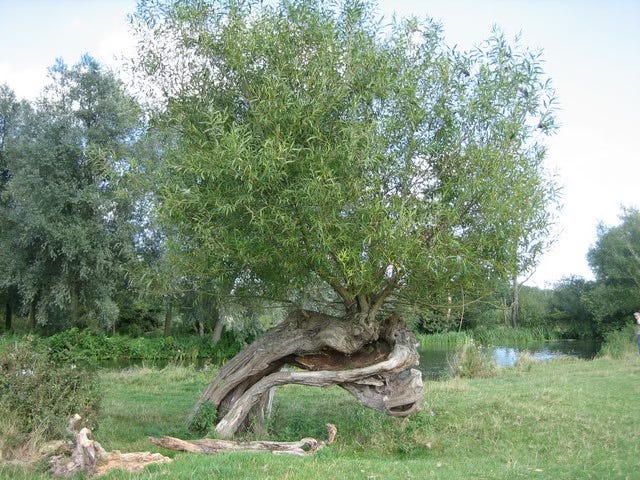
Zorba the Geek / Gnarled old willow on the banks of the Stour /
If you have ever wondered where some of our most promising pharmaceuticals come from look no further than the world outside. We live in biosphere that is interconnected in ways that dazzle and amaze the most grizzled observer. When we think of aspirin, the origins of aspirin date back to the times of ancient Greece—some 3500 years ago. The tree bark of the Willow is the source of its analgesic properties. The biological family name is, Salicaceae. The eventual chemical name is derived from the biological family name: salicylate. The salicylates are a broad family of anti-inflammatory drugs, and aspirin happens to be its most used drug of the salicylates. In fact, each Willow tree has dozens of salicylates resembling aspirin.
How did a small tablet (or two) come into such widespread use? It is a far cry from the bark of a Willow tree. Chemists needed to figure out what “aspirin” looked like chemically and molecularly. It is a carbon compound—thus, it is known as an organic molecule. Once its molecular structure was solved then its production needed to be streamlined. Isolating the precise molecular species from dozens of similar salicylate components the Willow tree can be tedious and costly. So, eventually chemists isolated the components and tested individual components (different salicylates). They realized each component upset the stomach and could be harmful in large doses. Ultimately, they sought a way to make dosing safer and more desirable. Eventually, they neutralized what make the salicylate unsafe and unpalatable. This, in a nutshell, is how aspirin came to be (1).
Another classic, naturally occurring substance that has important healing properties is St. John’s Wart (2). St. John’s Wart is an herbal remedy that had been used for centuries to elevate mood, and it is now shown to possess two psycho-active components. Each component acting in concert with the other to alleviate mild depression and anxiety. The issue behind St. John’s Wart is its broad spectrum of effectiveness. Bought online in some countries, the dosing becomes an issue. Not all species are grown equally- buyer beware.
Old Yet New—Pharmaceuticals from Plants
Peter J. Houghton
Journal of Chemical Education 2001 78 (2), 175
2. St John's wort (Hypericum perforatum L.): a review of its chemistry,
pharmacology and clinical properties.
Barnes, J., Anderson, L. A., & Phillipson, J. D.
Journal of pharmacy and pharmacology, 2001 53 (5), 583-600.