

Mercury Contamination
Pathways of Mercury consumption.

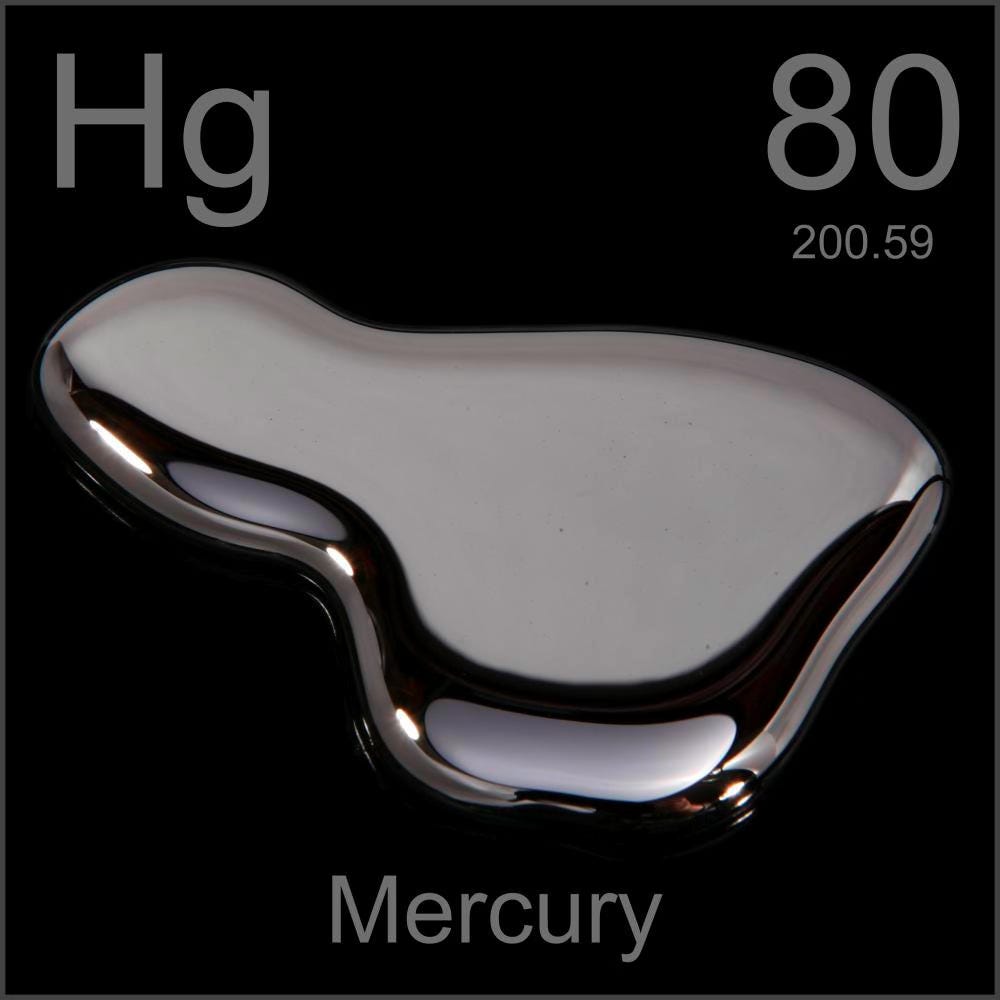
Elemental Mercury. Chemical symbol: Hg. It is naturally a liquid.
Marmall4, CC BY-SA 4.0 <https://creativecommons.org/licenses/by-sa/4.0>, via Wikimedia Commons
Mercury is a neurotoxin and it is a chemical element. Moreover, the world continues to grapple with climate change and its attendant issues like mercury poisoning. This is of course the age of man. Humanity can be best described as being one of the primary movers of its own destiny, and that should scare us for a couple of reasons, at least.
We live in a world that can be easily poisoned. Thus, it is imperative that we learn to live in harmony with nature and ourselves. We are a part of a foodchain that is increasingly becoming more contaminated—think of micro- and nano-plastics, for instance. Finally, while life is hardy, the world does not need humanity to keep thriving—the dinosaurs had a longer run than humans have had, thus far.
The question arises, how does mercury accumulate in fish?
Fish, like tuna, are a part of the foodchain. Tuna will eat contaminated stuffs (filled with mercury). This happens all the way to the bottom of the foodchain—from smaller fish to phytoplankton and algae. The mercury, in the form of methyl mercury, will deposit in the microalgae because it is easily absorbed. Small fish will eat the phytoplankton and larger fish will eat the small fish—and so on up the food chain. Ultimately, mercury is found in the edible flesh of all fish—both fresh water and salt water.
What does mercury do to the human body?
In adults, mercury poisoning affects fine and gross motor skills—it enters the brain by absorption through ingestion and eventually crosses membrane known as the Blood-Brain-Barrier. Normally the Blood-Brain-Barrier is impervious to most toxins. However, mercury will attach itself to amino acids that can cross the barrier. This, in effect, can affect motor skills in adults. Also known as Minamata’s syndrome, mercury poisoning will induce tremors, extreme behavioral alterations, and persistent insomnia. The symptoms can persist for several years after initial poisoning. Moreover, once mercury has crossed the blood brain barrier, there are no known treatments. Fetal exposure to mercury is known to induce cerebral palsy in new borns.
All human organs are adversely affected by mercury poisoning. However, there are methods of removing the poison that can not be done for the brain. Historical mercury poisonings are well known, as well. Being mad as a hatter—which was popularized by Lewis Carroll in Alice’s Adventures in Wonderland is the source of that turn of phrase. The goldmining towns of the Great California Goldrush of 1849 utilized mercury to extract gold from mines. Mercury pills were once utilized to treat syphilis and individuals succumbed to mercury poisoning. While mercury has a storied past, it should be noted that it remains one of the worst poisons.
Garcia-Arevalo Isabel, Jean-Baptiste Bérard, Johannes Bieser, Séverine Le Faucheur, Clarisse Hubert, Thomas Lacour, Bastien Thomas, Daniel Cossa, and Joël Knoery. “Mercury Accumulation Pathways in a Model Marine Microalgae: Sorption, Uptake, and Partition Kinetics.”
ACS ES&T Water Article ASAP
Branco V, Aschner M, Carvalho C. Neurotoxicity of mercury: an old issue with contemporary significance. Adv Neurotoxicol. 2021;5:239-262
Rice KM, Walker EM Jr, Wu M, Gillette C, Blough ER. Environmental mercury and its toxic effects. J Prev Med Public Health. 2014 Mar;47(2):74-83.
Spiller, Henry A., Hannah L. Hays, and Marcel J. Casavant. "Rethinking treatment of mercury poisoning: The roles of selenium, acetylcysteine, and thiol chelators in the treatment of mercury poisoning: A narrative review." Toxicology Communications 5.1 (2021): 19-59.
Zillioux, Edward J. "Mercury in fish: history, sources, pathways, effects, and indicator usage." Environmental indicators (2015): 743-766.