

Controlled Study of Pharmaceutical Contaminants in Fish
Everyday drugs are increasingly finding their way into the Biosphere.

Finding an Overarching Purpose?
As the biosphere continues to be assaulted through different avenues of man’s indiscretion, we as a species will feel the eventual reckoning. Moreover, there are quite a few individuals who do not believe what is plain to others—our waterways and oceans are increasingly contaminated by indiscriminate (and blatantly criminal) polluters. Ultimately, fish and other parts of the food chain are being contaminated. Moreover, according to the UN, “every day, the equivalent of 2,000 garbage trucks full of plastic are dumped into the world's oceans, rivers, and lakes” (UN Environment Program). It is a matter of time before a proverbial tipping point is reached, and we may not be able to readily return to more pristine environs. At that moment, the misfortune of our folly will impact many poor souls who may not have the recourse to implement changes in policy and law. However, before reaching the tipping point— it will be the truly marginalized who could be impacted from the overreach of polluters. They may not have the political voice to be truly heard.
Researchers from across the globe are racing to avert the eventual apocalyptic reckoning that the majority will face. To that end, researchers are gathering evidence to implement change. One such methodology is to provide concrete proof to lawmakers so governments can protect individual citizens through the enactment of international and local laws.
The Environmental Scenario?
Since Rachel Carson wrote her landmark book, Silent Spring, some individuals have been wary of what synthetic chemicals could possibly do to the environment. However, the chemical industry, for the most part, did not take her pronouncements seriously. And as most can testify, ‘follow the money’ has been the mantra that the chemical industry has followed by dismissing Carson as being misguided. However, as we watch the environment being degraded by polluters and the ill-informed alike, what may come to pass may truly be tragic.
“Contamination of the environment with diverse inorganic and organic compounds, such as pesticides, pharmaceuticals and metals, represents one of the main environmental challenges driven by anthropogenic activity” (Saaristo).
The combination of pharmaceuticals, metals, plastics, and pesticides in the environment poses a significant danger to the public. Despite numerous studies that have discovered pollutants in the environment, the scientific method calls for the evidence of environmental contaminants to be concrete. Researchers continue to investigate the effects of all pollutants on the environment.
Active Pharmaceutical Ingredients (APIs) in the Environment?
Pharmaceuticals find their way into the food chain because of the ‘innate’ inefficiencies of pharmaceutical manufacturing. Conventional means of pharmaceutical development are not one hundred percent efficient, and thus pollution is a part of the manufacturing equation. In an international study performed by more than 20 researchers, they systematically studied every continent and concluded all continents were polluted by pharmaceuticals of one sort or another
“The most frequently detected APIs were carbamazepine, metformin, and caffeine (a compound also arising from lifestyle use), which were detected at over half of the sites monitored” (Wilkinson).
The three drugs listed in the quote: metformin, carbamazepine, and caffeine are commonly used. Metformin is used to treat diabetes. Carbamazepine is used to treat nerve pain, bipolar disorder, and epilepsy. Finally, caffeine is a common stimulant found in coffee, tea, and soft drinks.
The question becomes at this juncture—how can we effect change?
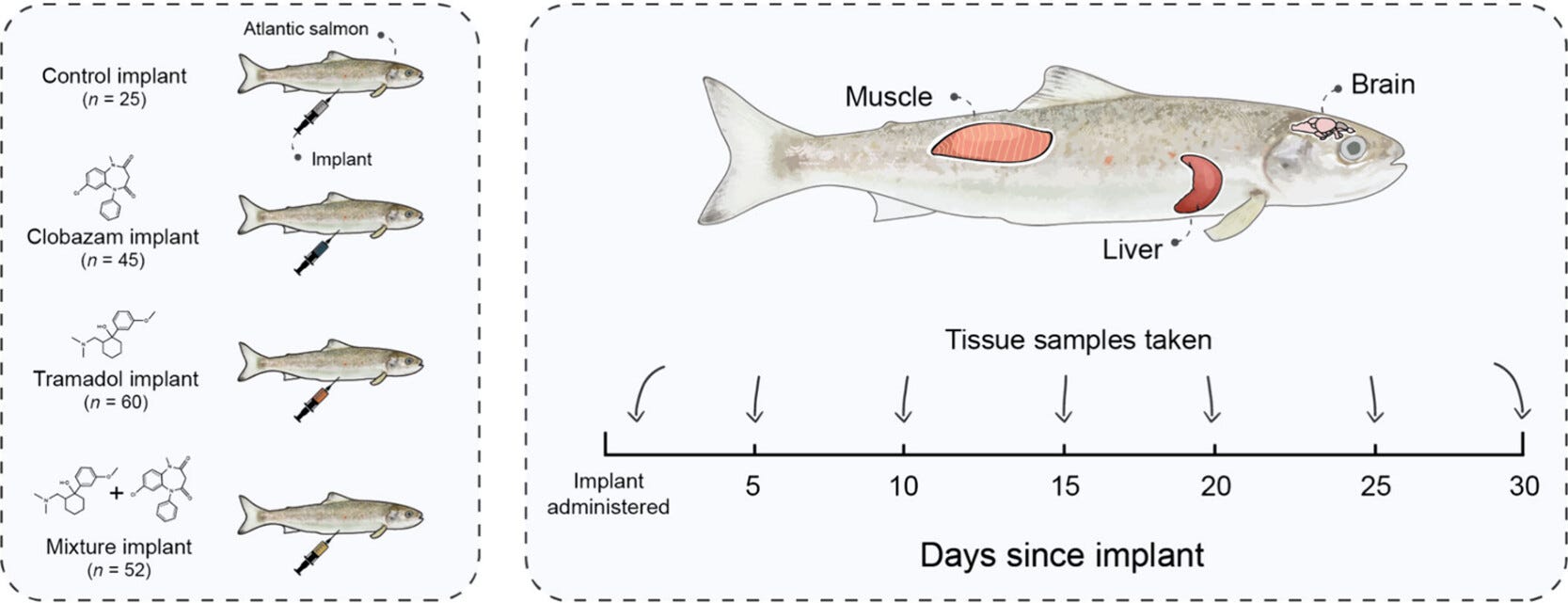
The scientific method demands proof be conclusive, and then legitimate policy makers can enact further legislation to ensure our safety. Scientists need to perform experiments to determine how APIs enter the bodies of fish and where the APIs are most likely to be found. In a landmark study performed by researchers of the EU, Atlantic salmon were ‘insulted’ with pharmaceuticals to ascertain how the drugs migrated through their flesh (Bertram). The findings were astounding but not surprising—all of the salmon were contaminated with pharmaceuticals. From muscle to vital organs, the salmon contained pharmaceuticals.
While the field of experimental science seemingly tends to plod –it is on a sure footing. More studies will need to be performed to better ascertain the effects of polluted waters on our fish populations.
Bertram, Michael G., et al. "Slow-Release Pharmaceutical Implants in Ecotoxicology: Validating Functionality across Exposure Scenarios." ACS Environmental Au (2024).
Saaristo, Minna, et al. "Direct and indirect effects of chemical contaminants on the behaviour, ecology and evolution of wildlife." Proceedings of the Royal Society B 285.1885 (2018): 20181297.
UN Environment Program, “Plastic Pollution.” https://www.unep.org/plastic-pollution.
Wilkinson, John L., et al. "Pharmaceutical pollution of the world’s rivers." Proceedings of the National Academy of Sciences 119.8 (2022): e2113947119.