

Cement Recycling
Cement production is a major producer of greenhouse gas.

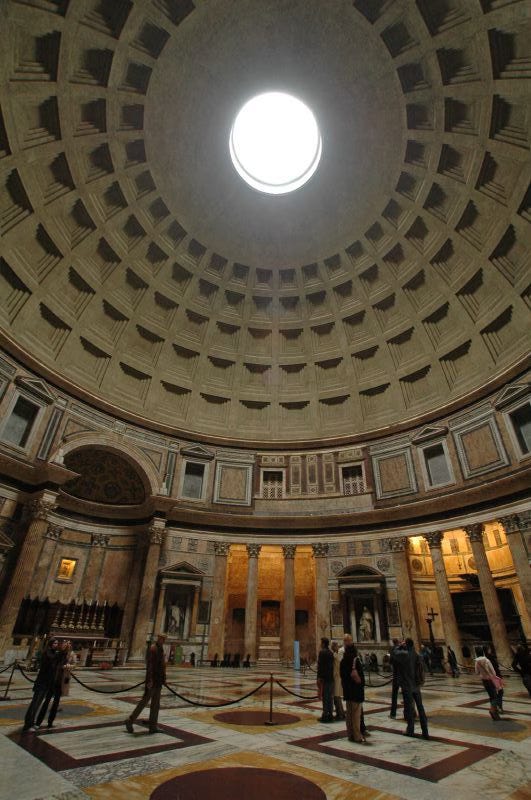
Roman Pantheon has stood the test of time because of Vesuvian cement’s properties.
Flickr user: Andrew Wales berks, uk http://www.spaceriot.com/, CC BY 2.0 <https://creativecommons.org/licenses/by/2.0>, via Wikimedia Commons
Cement has a storied history. Its first purported use was in ancient Rome. The ancient Romans formulated cement from the fallout ash of Mount Vesuvius. Roman concrete is well-known for its healing properties and has stood the test of time as evidenced by the Roman Pantheon. The Roman formulation—decoded in 2023 after years of speculation—consists, in part, of volcanic ash, calcium oxide, gravel, and sand (Gramling).
As is well-known to climate scientists, concrete production is a major producer of greenhouse gas. Thus, finding a way to recycle used concrete could go a long way to reducing one source of greenhouse gas. While cement production does not produce as much greenhouse gas as gas-guzzling vehicles, its elimination would be noticeable. Well, researchers seem to have found a way to do that, and the methods are now ready for the real world. It is not a laboratory curiosity.
Researchers from the University of Cambridge in the UK report recycling Portland cement reduces greenhouse emissions as well reduced energy use for by recycling as opposed to its production. While the process of creating Portland cement is considered to be an energy efficient process, its recycling is a more optimal process to produce cement. The researchers from the University of Cambridge used the following process to recycle the cement: the process is used in co-production with steel recycling. Quoting the researchers—
“The process is fundamentally a material substitution within existing processes, equipment and standards, and so it could scale rapidly. It creates the first zero-emissions alternative to existing cement production, to our knowledge, which accounts for 7.5% of the present anthropogenic emissions” (Dunant).
Moreover, using the identical machinery that is employed to re-cycle steel will provide an economic impetus to revitalize industries throughout the world.
Dunant, Cyrille F., et al. "Electric recycling of Portland cement at scale." Nature (2024): 1-7.
Carolyn Gramling. “These chemists cracked the code to long-lasting Roman Concrete.” Science News, January 2023.
https://www.sciencenews.org/article/chemists-long-lasting-roman-concrete
Here you go: https://mugenkioku.com/sustainability/enso-circular-economy/