

Cannabis
A drug with a checkered past.

Lokal_Profil, CC BY-SA 2.5 <https://creativecommons.org/licenses/by-sa/2.5>, via Wikimedia Commons
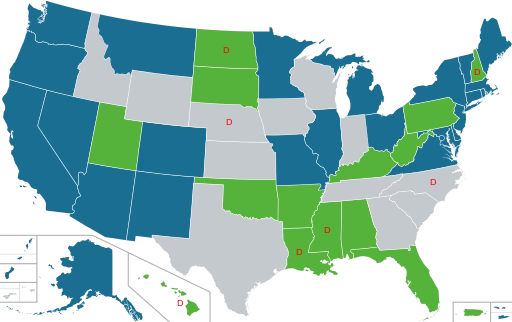
More than two-thirds of the U.S. legalized some form of pot use in 2023. The Blue states have legalized recreational use of pot. The green states have legalized pot for medical purposes, and the states marked with a letter D have decriminalized its use as well.
Marijuana is a somewhat notorious drug. Known for its euphoria-inducing properties, the drug is still illegal in fewer than fifteen U.S. states. However, primary care physicians are turning to this ancient medicincal to treat anxiety, depression, PTSD, and to allay the nauseating affects of cancer chemotherapy drugs. Its notoriety, perhaps, first came about in 1936 with the anti-drug, propaganda movie, Reefer Madness. Since then, the rest is history. However, in the 1990s - 2000s, a push was made from the fringes of the medical community to take a closer look at what at the time amounted to anecdotal evidence surrounding its curative, medical properties. Moreover, not only did cancer patients benefit from its use, but so did those with significant mental illnesses. So in the 1996, California became the first state in the country to legalize marijuana for medical purposes; and much like a row of dominos, other states followed California’s lead.
However, like any drug, there are some downsides to its medicinal properties. Namely, the current crop of commercialized pot is more potent than what was used on the street in the 1960s and 1970s when its renaissance was first in bloom. So, lets take a look at what some of properties that commercial pot brings to the common person. In an article appearing in The Journal of Food and Agriculural Chemistry in 2024, the authors evaluated farmed, Canadian pot in order to glean a perspective of what was really in this substance. Here is some of what they found:
There are more than 6000 chemical constituents in commercial cannabis. The types of chemicals range from THC to CBD to potassium metal ions.
THC is still considered to be the primary inducer of the “most wanted therapeutic” effect. However, CBD is another comound that induces euphoria and an altered sense of time, just to name two of them.
Pesticides are among the chemicals found in commercialized cannabis. Among the known pesticides, the following were present: malathion, mevinphos, methoprene, MGK-264. The commercialized names of these four pesticides are the following: Spectracide insecticide, Phosdrin insecticide, Methoprene insect growth regulator, and Versys insecticide.
It must be stated: as long as the Food and Drug Administration does not regulate these pesticide residues in the commercialized cannabis your state or country, you should treat anything you buy as potentially suspect.
The road to cannabis legalization across the land is a slippery slope. It is fraught with legal landmines that, if not cautious, you may find yourself ingesting a little bit more than you bargained for.
If you absolutely must use this substance, do your homework first.
Reference:
Journal of Agricultural and Food Chemistry Article ASAP
“Chemical Composition of Commercial Cannabis,” Journal of Agricultural and Food Chemistry. Published on-line January 5, 2024.
David S. Wishart, Mickel Hiebert-Giesbrecht, Gozal Inchehborouni, Xuan Cao, An Chi Guo, Marcia A. LeVatte, Claudia Torres-Calzada, Vasuk Gautam, Mathew Johnson, Jaanus Liigand, Fei Wang, Shirin Zahraei, Sudarshana Bhumireddy, Yilin Wang, Jiamin Zheng, Rupasri Mandal, and Jason R. B. Dyck
https://doi.org/10.1021/acs.jafc.3c06616