

Biological clocks?
A subtle concept pervasive to life.

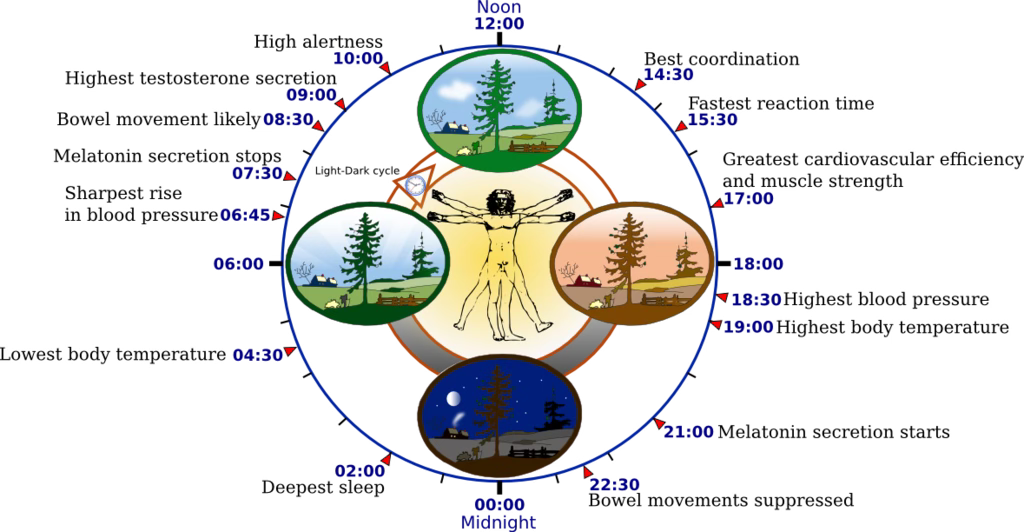
The typical circadian rhythym for the common man.
https://commons.wikimedia.org/wiki/File:Biological_clock_human.PNG GYassineMrabetTalk This PNG graphic was created with Inkscape. https://creativecommons.org/licenses/by-sa/3.0

Sleep is imperative if you want to be your best. Sleep is apart of a our biological clock (or circadian rhythm). Natural philosophers from the ancient Greeks often wondered why we must sleep or how we age. The answers come from the 24 cycle of the earth’s rotation (Schwartz). From this comes the concept of a biological clock.
However, the concept of a biological clock is a fairly recent development. Twentieth century scientists noticing the patterns of night and day in bean plants assigned a daily rhythm to plant growth cycles. The first scientist was a Dutch woman botanist—Anthonia Kleinhoonte. Anthonia Kleinhoonte studied bean leaves and she discovered the rhythmic movements corresponding to darkness and light cycles of night and day in 1929 (Kleinhoonte).
Since that time, advances have proceeded in an exponential manner. From demonstrations of night-day cycles to the realization that our biological clock can predict our true age (and perhaps our eventual deaths), biological clocks are life’s response to rhythmicity on our planet.
Namely, according to LeClerq and co-workers,
“A biological clock can be defined as: an innate mechanism that controls the physiological activities of an organism which change on a daily, seasonal, yearly, or other regular cycle“ (LeClerq).
Some of the early biological scientists studying circadian rhythms wondered whether there was a genetic constituent to circadian rhythms— or, even more speculatively, a chemical component. Namely, circadian rhythms were biological in origin and not strictly governed by chemical reactions. However, when we attempt to assign a mechanistic understanding to circadian rhythms, chemical reactions can be discerned as fundamental driving forces behind the genetics.
Moreover, LeClerq further states,
“With the dawn of the molecular revolution many methods have been developed that use DNA to ascertain and study critical individual characteristics as well as population attributes within most species” (LeClerq).
DNA is subject to degradation as an organism ages—thus, an accurate assessment of age can be gotten from studying the DNA in our chromosomes.
In the 1950s, scientists made breakthroughs that paved a way for a physico-chemico explanations to be employed in understanding circadian rhythms. They experimented with the temperatures of fruit fly metabolism as the fruit fly experienced cycles of light and dark. The result paved the way for further experimentation with different physico-chemico parameters.
In 2017, three researchers were awarded the Nobel for their work on circadian rhythyms in 1980-90s (Nobel). Jeffrey C. Hall, Michael Rosbash and Michael W. Young also worked on fruitflies to help discern how organisms responded to daily cycles.
Le Clercq, Louis‐Stéphane, et al. "Biological clocks as age estimation markers in animals: a systematic review and meta‐analysis." Biological Reviews 98.6 (2023): 1972-2011.
Kleinhoonte, Anthonia. (1928) De door het licht geregelde autonome bewegingen der Canavalia- bladeren. Meinema, Delft, 142 pp
Advanced information. NobelPrize.org. Nobel Prize Outreach AB 2024. https://www.nobelprize.org/prizes/medicine/2017/advanced-information/
Schwartz, W. J., & Daan, S. (2017). Origins: A brief account of the ancestry of circadian biology . In V. Kumar (Ed.), Biological Timekeeping: Clocks, Rhythms and Behaviour (pp. 3-22). Springer (India) Private Ltd. https://doi.org/10.1007/978-81-322-3688-7_1
Adapted illustration:
The work was done with Inkscape by YassineMrabet. Information was taken from "The Body Clock Guide to Better Health" by Michael Smolensky and Lynne Lamberg; Henry Holt and Company, Publishers (2000). Landscape was sampled from Open Clip Art Library (Ryan, Public domain). Vitruvian Man and the clock were sampled from Image:P human body.svg (GNU licence) and Image:Nuvola apps clock.png, respectively

