
Astrochemistry
From deep interstellar space, we may glimpse the beginnings of life’s early chemistry.

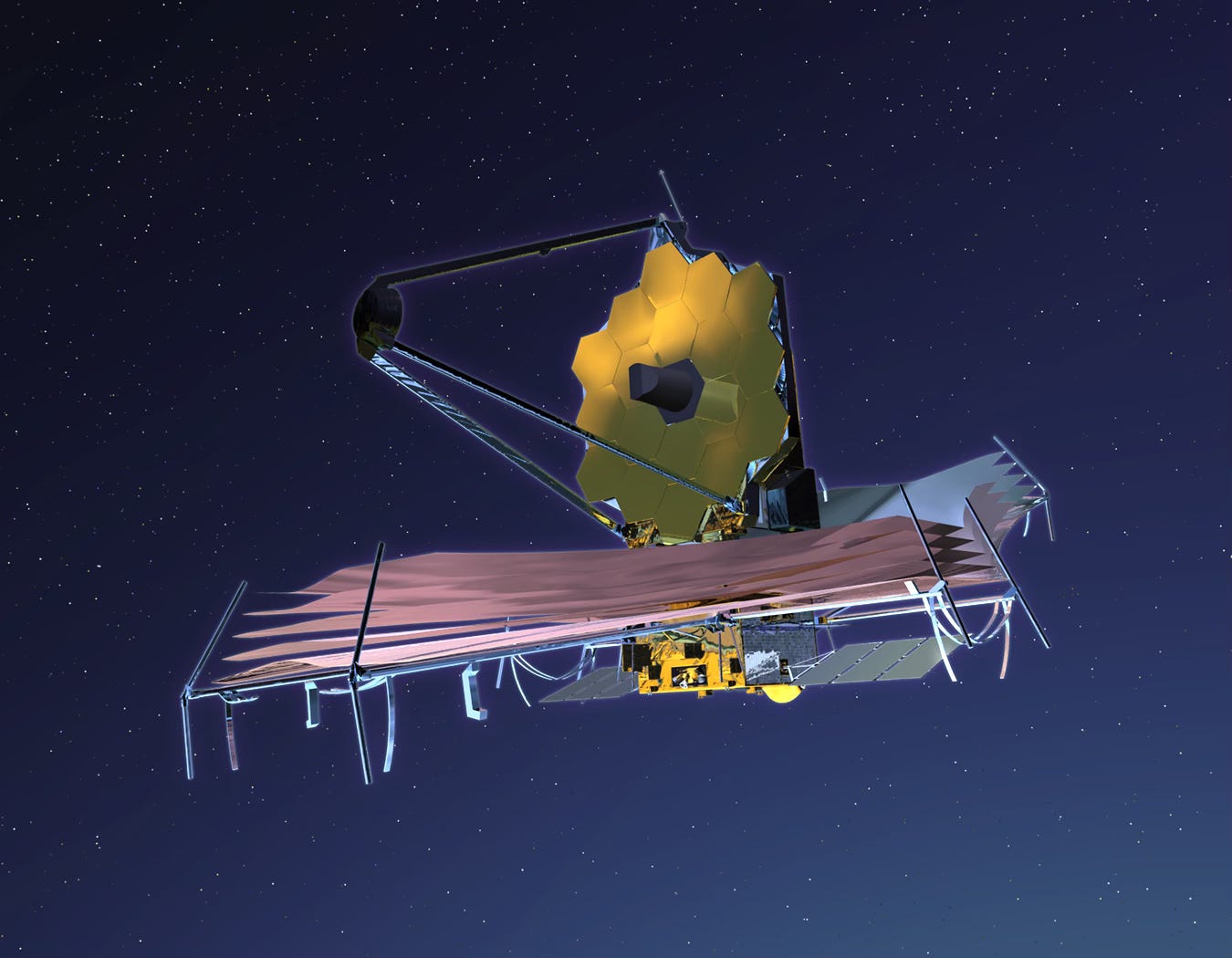
James Webb Telescope heralds a new era of exploration
http://www.jwst.nasa.gov/
Astrochemistry is a newer field of endeavor, and it is interdisciplinary in scope. The ultimate goal of the field is to understand where it all came from chemically. The field is also concerned with current processes within the interstellar medium: understanding the dust and gaseous materials between solar systems, galaxies, and stars.
In the Hot Big bang model, what is taken to be the current model: minutes after the Universe’s creation, the first chemical element was formed: hydrogen. Moments later, molecules were forming from these hot elements: the hydrogen molecule. At this point, many additional deatails are speculative. Whether hydrogen molecules “clumped together” to form massive hot stars or galaxies forming first from further chemical syntheses is still actively researched. However, larger molecules formed as the early Universe cooled. Because many details remain unclear, astrochemists study interstellar space to try to discern the processes. Some of the more prominent means to study interstellar space by visualizing it with these telescopes: Spitzer, James Webb, and Hubble. They also utilize computaional chemistry to discern what their telescopes may potentially visualize from the imaging process. Quantum chemical computations can help discern what is possible.
How does James Webb work, in a nutshell —and how does an infrared (IR) image tell us what is in the interstellar medium (ISM)? The James Webb telescope is located in space at a stable point away from the earth (that point is known as L2 or the second Lagrange point). The telescope produces images (aka spectra): light broken apart into its components from the distant source. The telescope is specifically designed to ‘see and measure’ heat images from a source. In somewhat of the same way that night vision goggles can pick-out heat images — infrared spectrun will enumerate components from warmer parts of the image. Every molecule and atom has a characteristic spectrum that is, in part, governed by temperature. A molecule, when struck by light (or energy) will vibrate and ‘be excited.’ As it cools down, it will emanate a characteristic spectrum that can be enumerated— every molecule has a spectal number associate with it that can be classified like finger print. These interstellar molecules are excited in distant space. Because we can see them, we can characterize them —and in this case it can be done via James Webb. [It is truly profound.]
Astronomy is one of my favorite subjects. There is little gloom and doom to it. More to point, it is filled with possibilities. When President John F. Kennedy made his pronouncement the early 1960s of going to the moon, I was a small child. It was an exciting time for the USA. Moreover, the 1969 moon landing stoked my imagination forever. Watching the moonlandings of late 1969 and the early 1970s made the USA feel as if it could do anything. The moonshot made many of us into astronauts, astronomers. scientists, and engineers. It was an influencing factor in my life to gain a degree in chemistry and to write popular science, as well.
A Vision for the Future of Astrochemistry in the Interstellar Medium by 2050
Ryan C. Fortenberry
ACS Physical Chemistry Au 0, 0, pp
DOI: 10.1021/acsphyschemau.3c00043